Walls you want stiffer
Sprayed into wall frame cavities, closed cell makes the frame much better at resisting being pushed out of square. A federal guide counts that as an advantage where hurricanes and earthquakes are a concern.
Drafty walls, a hot room upstairs or damp air from the crawl space? We find the cause, then spray dense foam that seals and insulates.
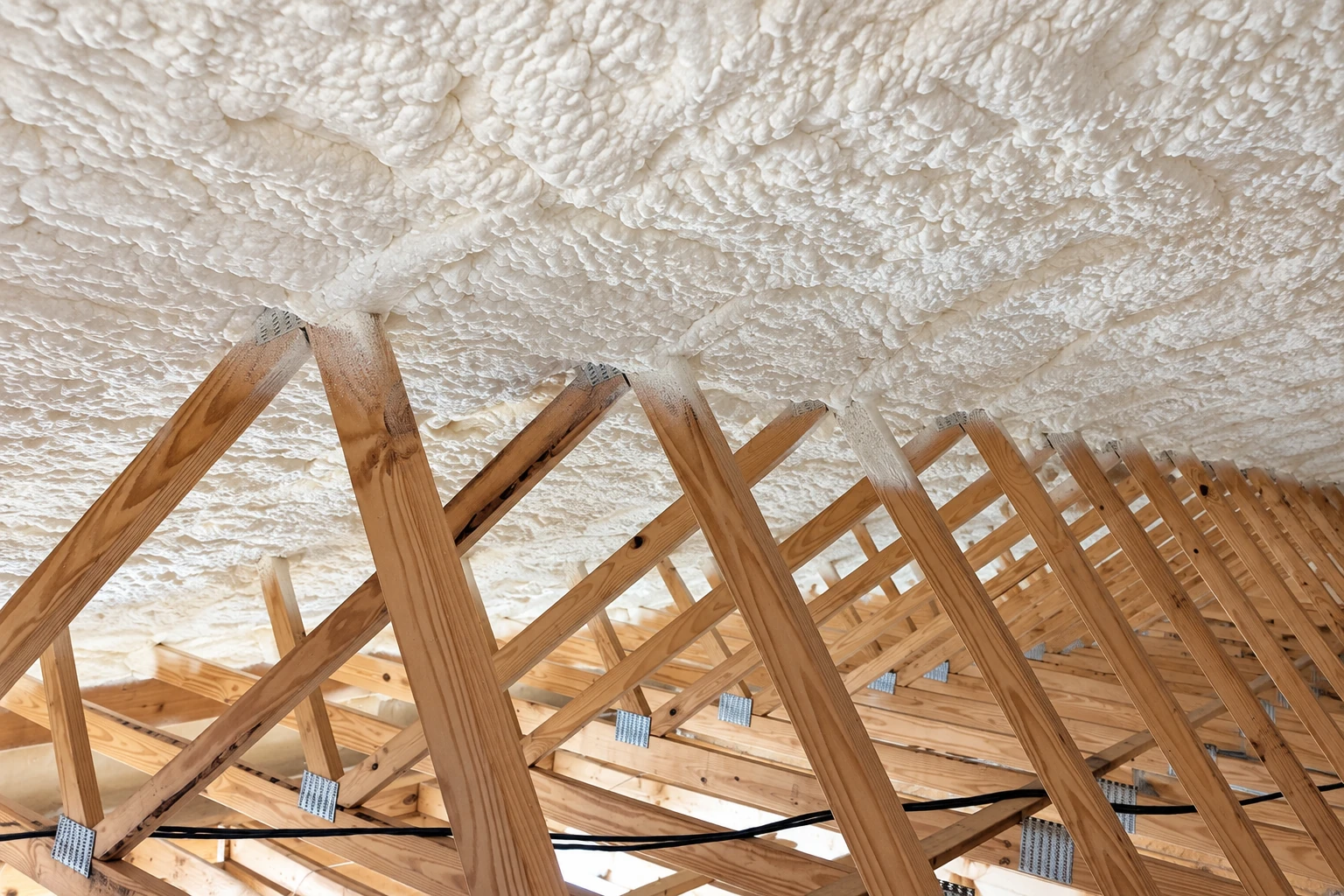
Closed-cell foam insulation in Conway is a rigid, dense spray foam that slows heat, blocks moisture vapor and won't soak up water, which makes it a good fit for walls, crawl spaces and attic rooflines.
Most calls start with a hot room upstairs, cold floors over the crawl space or a power bill that keeps climbing, and closed cell is one answer to those, not the only one. The price moves with how many square feet you want covered and how thick, whether old insulation has to come out first, whether the walls and ceilings are already finished, and how hard the attic is to reach. The schedule turns on the same things, plus any permit the job needs, and since permit rules differ from city to city, I check with the local office before we start and take care of the permit if one's required. My estimate writes down what I found and what I'd do, in the order I'd do it, so you're deciding on your own house and not a guess.
I come out to every job myself and check what's already in your walls, attic or crawl space, because foam sprayed over a wet or damaged spot just hides the problem.
If I find soaked insulation, droppings or a leak, I'll tell you it has to be fixed before anything new goes in. I'd rather say that up front than bury it under foam.
Our crew does the work with me or a lead installer on site, so somebody who walked your house is watching the coverage at the edges, where foam jobs usually come up thin.
First I go through the house and look under what's there, because new foam over soaked or dirty insulation keeps the old problem. On attic jobs I tell you up front if the old floor insulation has to come out, so it's in the plan and the price from the start. Then our crew does the prep. We pull out what has to go, seal the gaps around pipes, wires and the hatch, and cover everything that shouldn't get foam on it. We spray in passes so the edges and corners end up as deep as the middle, then trim, clean up and walk the finished work with you.
Closed cell costs more than open-cell foam insulation, but it packs more into each inch and stiffens the wall, so I lay the two side by side and let you weigh them for your house. Building owners call about shops and offices too, and that's handled through our commercial insulation work.
Sprayed into wall frame cavities, closed cell makes the frame much better at resisting being pushed out of square. A federal guide counts that as an advantage where hurricanes and earthquakes are a concern.
Because it holds up where damp air or a little water can reach it, closed cell fits places like crawl space walls and the rim joist, the board that sits on the foundation.
Foam costs more and seals air while it insulates. In most attics, sealing the gaps and topping up loose fill wins, unless your ductwork runs up there. Then I'd lean toward foam.
That room is usually the hardest to keep comfortable, with cold air under the floor and outside walls around it. Closed cell in the floor and walls slows heat and stops drafts together.
Send the form and we'll reply within one business day to set a time. I come out myself, look at the spaces you want insulated and write down what I found and what I'd do, with no obligation.
List the walls, attic, crawl space or garage room you're thinking about, since how much area gets foam and how thick it goes set most of the price.
Let us know if the walls and ceilings already have drywall up, because spraying into finished spaces takes more work than spraying open framing.
Tell us how you get into the attic and what's up there now, because a tight hatch or old material that has to come out changes the plan.
Examples of closed-cell and open-cell foam in walls, attics and crawl spaces, to help you picture finishes and coverage before we talk.
Straight answers to what people ask most about closed-cell spray foam, from price and permits to old attic insulation.
Closed cell is better at holding heat back, about twice as efficient per inch, and that's part of why it costs more. Open cell is much better at blocking sound, though. So it comes down to what matters most to you: the most insulation in the least space, a quieter house, or a lower price.
Closed-cell spray foam in Conway usually costs about $2,800 to $4,200 for 3,000 board feet, which works out to 1,000 square feet sprayed 3 inches thick. That's the going rate in the area, not our quote, and your figure moves with the things I listed near the top of this page. The estimate gives you your own number.
If foam on the roofline turns your vented attic into a sealed one, industry work specifications call for taking out all the old insulation and vapor retarder on the attic floor. The gable, ridge and roof vents get covered with backing so the foam has something to go on. Plan for both as part of the job.
Ask the city, because its permit list names new construction, remodels, additions and accessory buildings, not insulation work by itself. All construction in Conway still has to meet adopted codes, including the Arkansas Energy Code and the Arkansas Fire Prevention Code. The city's permit office takes questions at 501-450-6107 or permits@conwayarkansas.gov, and a residential review may take up to 3 to 5 business days with complete plans.
For home improvement work in Arkansas, a Limited license covers only residential projects under $50,000, counting labor and material together, while an Unlimited license covers jobs of any size. It's fair to ask any contractor which one they hold before you sign anything. We're licensed and fully insured, and I'm glad to answer that question on site.
If you're planning a remodel, call (501) 273-0205 now so the foam can go in while the wall framing is still open.