Bare dirt with nothing over it
Bare dirt under the house is the plainest case we see, and once the space is clear, the job is mostly laying a first liner across the floor and sealing it.
Bare dirt or a torn liner under your house? We fix what's wrong down there first, then lay a sealed, fastened liner.
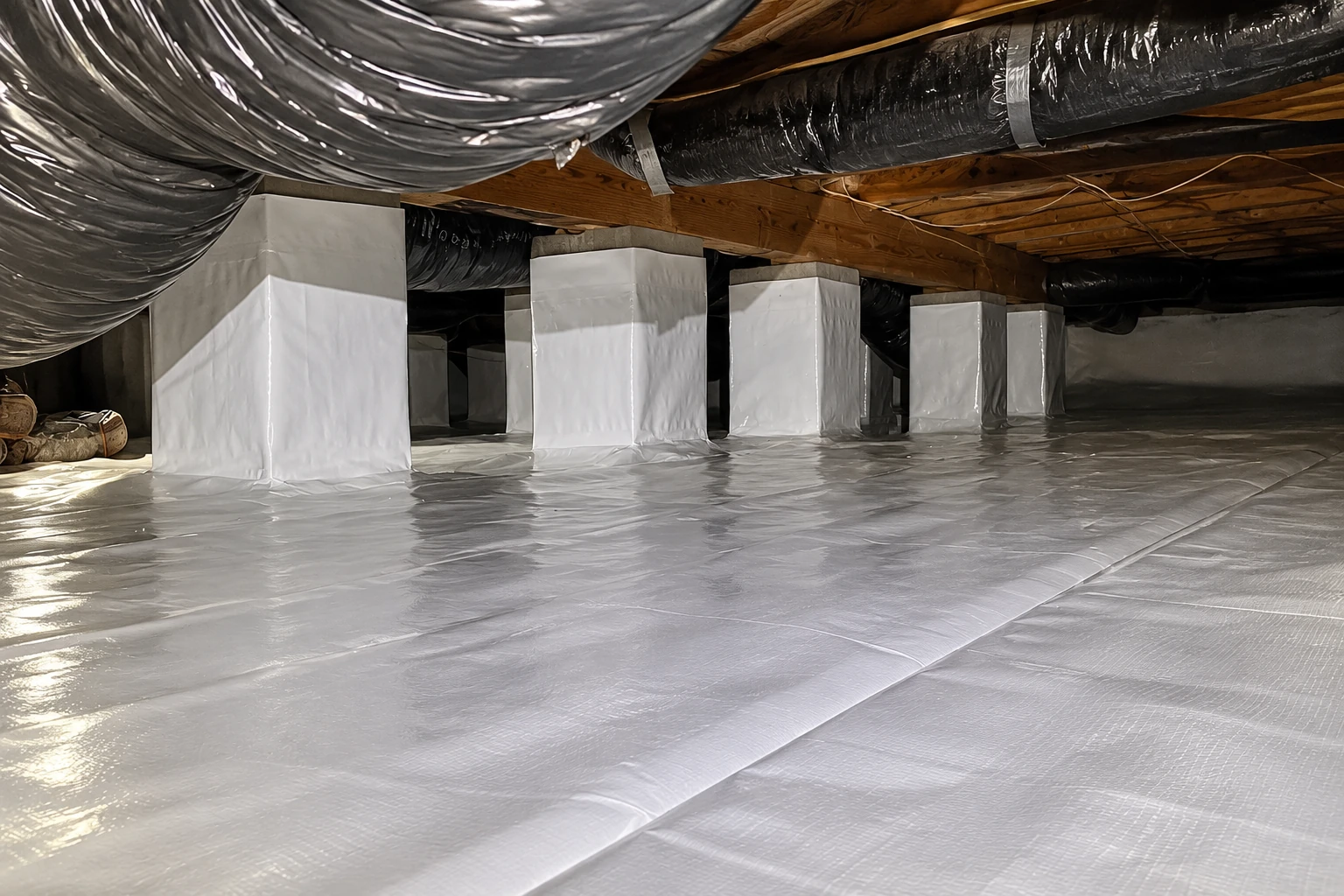
A crawl space vapor barrier in Conway is a sheet of plastic laid over the ground under your house and sealed, so moisture from the dirt stays down there instead of working up into your floors and rooms.
Most people call us after they've looked under the house and found bare dirt, a liner that's torn and loose, or a wet spot they don't like. The price depends on how big and how low the space is, how much has to come out before we can work, whether water, mold or rotten wood needs fixing first, and whether your old liner gets patched or covered with a new, heavier one. The schedule depends on that same prep work, so a dry, empty crawl space goes quickly and a wet one waits until the water's handled. Permit rules differ from city to city, so I check with the local office before we start and take care of the permit if the job needs one. You get your own figure from the estimate, where I write down what I found and what I'd do, in the order I'd do it.
I come out and look at your crawl space myself before anyone gives you a number, because what's already down there decides what the job really is.
Our crew does the work with me or a lead installer on site, so someone who knows the plan is right there to answer your questions while we work.
We're licensed and fully insured, and our work is satisfaction guaranteed. I started this business in Conway in 2023 after years running another contractor's insulation jobs.
I start by crawling the space myself, because standing water, mold, rotten wood or anything hazardous down there has to be handled before a new liner goes in, or the plastic just hides the problem. Once that's dealt with, I'll tell you honestly whether your old liner can be patched or is better covered with a new one. Then we clear out stored things and debris so the liner can reach every part of the floor. We lay and seal the plastic, fasten it so it stays put, and clean up before we leave.
A crawl space liner is often one part of a bigger job. If moisture is getting into other parts of the house, our vapor barrier installation work covers those spots too. Air that leaks out through the top of the house gets replaced by air pulled up from below, so attic air sealing means less of that crawl space air ends up in your rooms.
Bare dirt under the house is the plainest case we see, and once the space is clear, the job is mostly laying a first liner across the floor and sealing it.
Old plastic that's ripped, bunched up or hanging off the walls lets ground moisture through, and we'll weigh patching it against covering it, as the questions below explain.
Plain plastic needs protecting where someone crawls through to service equipment, and thicker reinforced liners hold up better, so if your ducts or furnace are down there, ask about a reinforced liner.
Department of Energy guidance is to cover the whole floor, or close to it, run the liner up walls, columns and footings, and overlap every seam, so ask how a quote handles each.
Send the form and we'll reply within one business day to set a time. I come out, look at your crawl space and write down what I found and what I'd do, free and with no obligation.
If you've seen standing water, mold or soft wood down there, say so in the form, because that work comes first and I'll come ready to look for it.
Let us know whether there's plastic down already and roughly what shape it's in, so I can plan to judge whether to patch it or cover it.
We answer (501) 273-0205 Monday through Friday from 6 AM to 10 PM and weekends from 8 AM to 10 PM, if you'd rather talk it through.
These example photos show liner weights, taped seams and plastic run up walls and piers, so you can point to what you want when we talk.
Here's what Conway homeowners usually ask about crawl space liners, from repairing an old one to cost and permits.
National building science guidance says every crawl space should have one, because bare ground gives off moisture and soil gases that get pulled up into your house through cracks around the subfloor. A well-installed liner also helps keep down soil gases like radon. If yours is bare dirt, it's worth having someone look.
Often it can be repaired when the trouble is open seams or plastic pulled loose from the walls and piers, by taping the tears and seams and fastening it back up the walls. A new layer laid over it, sealed and secured, holds up better. So you're weighing a repair against a sturdier new layer.
Crawl space encapsulation with a vapor barrier and a dehumidifier usually costs about $4,250 to $8,000 per home in Arkansas. That's the usual range across the state, not our price, and a liner by itself doesn't include the dehumidifier. We give estimates on site in Conway and the cities around it, from Morrilton out to Beebe and down to Bryant.
The City of Conway's permit list names new construction, remodels, additions and accessory buildings, not crawl space vapor barriers, so the list alone doesn't settle it. Electrical, plumbing, gas and mechanical work each need their own city permit, which can matter if the job adds wiring for a dehumidifier. You can ask the city at 501-450-6107 or permits@conwayarkansas.gov.
In humid climates, building scientists recommend an insulated crawl space with no vents, because damp outside air comes in through the vents and condenses on cooler framing. Closing vents is a bigger job than laying plastic, since the space then needs crawl space insulation and a way to control moisture, so it's best decided with the whole crawl space in view.
Call (501) 273-0205 or use the form, and if nothing down there needs work, I'll tell you that plainly.